
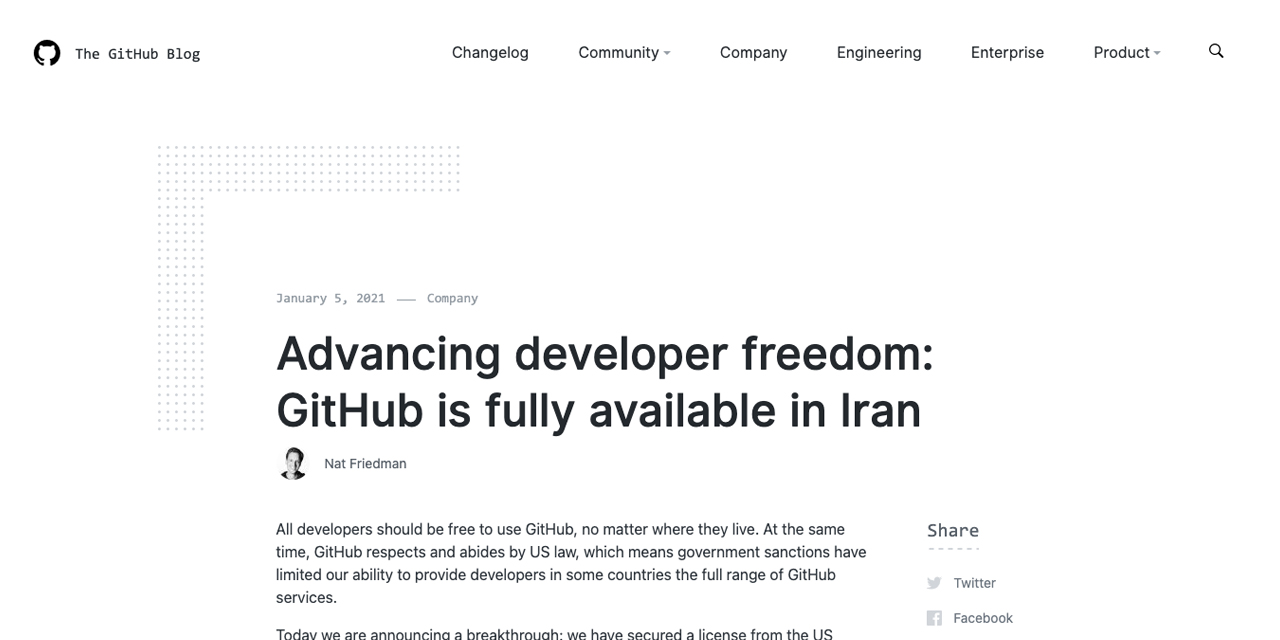
On January 5, 2021, GitHub’s official blog published Advancing developer freedom: GitHub is fully available in Iran. Iranian developers had previously been blocked because of US sanctions.
Before we get to that post, there’s another story. On December 30, 2020, the CEO of a European company angrily @-mentioned GitHub’s support account on Twitter: one of my employees opened a laptop while visiting family in Iran, and you banned my entire company’s account! Deployment completely blocked!
Several days later, on January 4, there was still no sign of things improving. And all of this happened just because one employee opened a computer in Iran — meaning any IP coming out of Iran gets you banned. The United States has long maintained broad sanctions against a number of countries including Iran, prohibiting any US company from doing business with anyone in a sanctioned country. Back in 2019, GitHub already restricted access for developers in Iran and several other countries (Crimea, Syria, and so on).
Then, not long ago, on January 5, 2021, GitHub’s blog published Advancing developer freedom: GitHub is fully available in Iran. These changes come from a license granted by the Office of Foreign Assets Control (OFAC), the sanctions enforcement arm of the US Treasury. My translation follows:
All developers should be free to use GitHub, no matter where they live. At the same time, GitHub respects and complies with US law, which means government sanctions limit our ability to provide the full range of GitHub services to developers in certain countries.
Today we are announcing a breakthrough: we have obtained permission from the US government to provide GitHub to developers in Iran. This includes all services for individuals and organizations, including free and paid private and public services.
So what happened here?
The United States has long maintained broad sanctions against a number of countries including Iran. These sanctions prohibit any US company from doing business with anyone in a sanctioned country. (These sanctions can also apply to non-US companies whose activities touch the US directly or indirectly, including payments made merely through US banks or payment mechanisms like Visa.)
Accordingly, in 2019 GitHub restricted access for developers in Iran and several other countries in order to comply with US sanctions law. At the same time, in pursuit of our goal that GitHub be available to everyone, we immediately took two additional steps:
First, even as we complied with sanctions, we still did everything we could to make as much GitHub available to as many developers as possible under US sanctions law, including public repositories even in sanctioned countries.
Second, we brought our case to the Office of Foreign Assets Control (OFAC) at the US Treasury and began a long and intensive process of advocating for broad, open access to GitHub in sanctioned countries.
Over the past two years, we were able to demonstrate how developers’ use of GitHub advances human progress, international exchange, and the enduring US foreign policy of promoting freedom of expression and the free flow of information. We are grateful for OFAC’s engagement, which produced such a fruitful outcome for developers.
We are removing all restrictions on Iranian developers and restoring full access to affected accounts. Developers with questions about their accounts or who need help should visit our help page.
We have more work to do. We want every developer to be able to collaborate on GitHub, and we are working with the US government to ensure that developers in Crimea and Syria obtain similar licenses.
So Iran got its exemption, but Crimea and Syria have not yet — GitHub says it will keep pushing to obtain exemptions for them too.
Open source still has borders. China has already prepared its own public code hosting platform, Gitee. But as developers and software companies, we should still keep an internal code repository of our own ready, just in case.