This post supplements Data Extraction Methods in Big Data ETL — read that one first if you haven’t. Building on it, this post tackles how to compare data quickly when the volume is enormous.
Last post hashed the digest of every field in each row, compressing dozens of fields into a single hash to speed up comparison. But that only compressed the fields — the row count stayed the same. With billions of rows we still can’t find the changed records fast enough.
Locality-Sensitive Hashing
Suppose both sides hold a trillion rows. Following the comparison approach from last post, how many comparisons would we make? A trillion times a trillion, because we’d traverse both sides — obviously unworkable. So instead we can batch the data into chunks and hash them.
After hashing the fields, sort by id and group every ten thousand rows: ids 1-10000, 10001-20000, 20001-30000, and so on. Concatenate the hashes within each group and hash the result again to get that group’s hash — the locality-sensitive hash over the whole dataset. A trillion rows get split and compressed into a hundred million locality hashes. Compare values group by group, and whenever one differs, compare the per-row hashes inside that group to find the inconsistent records.
An Example
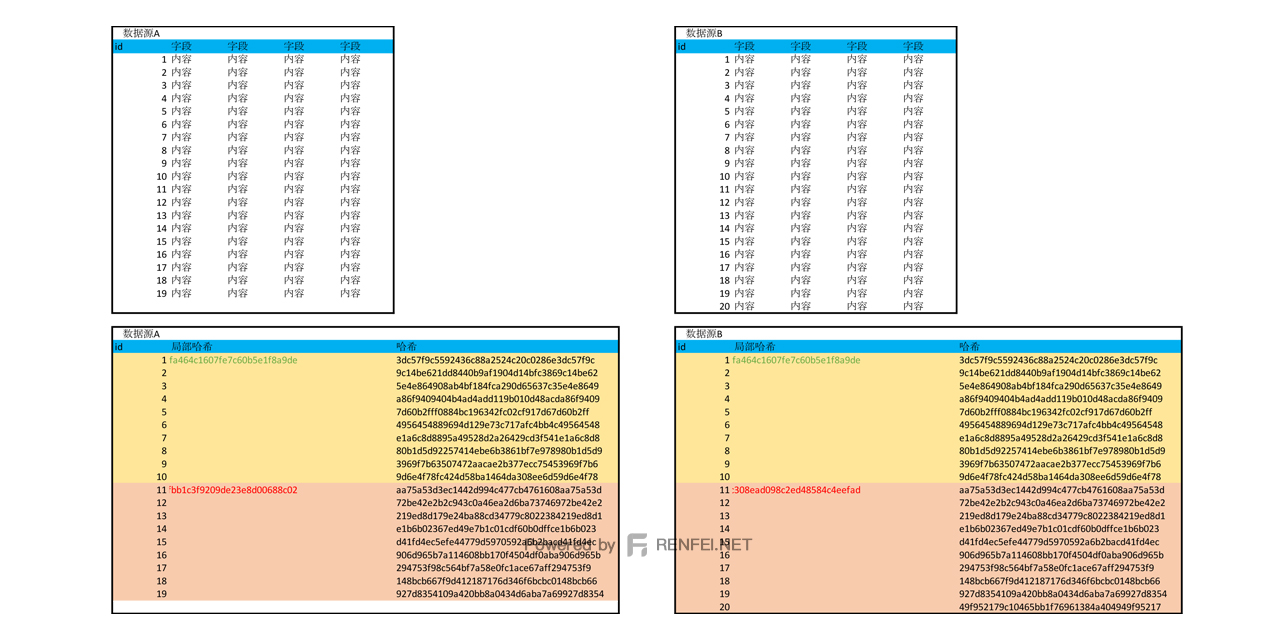
For simplicity let’s use 20 rows, from data source A and data source B:
| id | field | field | field | field |
|---|---|---|---|---|
| 1 | content | content | content | content |
| 2 | content | content | content | content |
| 3 | content | content | content | content |
| 4 | content | content | content | content |
| 5 | content | content | content | content |
| 6 | content | content | content | content |
| 7 | content | content | content | content |
| 8 | content | content | content | content |
| 9 | content | content | content | content |
| 10 | content | content | content | content |
| 11 | content | content | content | content |
| 12 | content | content | content | content |
| 13 | content | content | content | content |
| 14 | content | content | content | content |
| 15 | content | content | content | content |
| 16 | content | content | content | content |
| 17 | content | content | content | content |
| 18 | content | content | content | content |
| 19 | content | content | content | content |
| id | field | field | field | field |
|---|---|---|---|---|
| 1 | content | content | content | content |
| 2 | content | content | content | content |
| 3 | content | content | content | content |
| 4 | content | content | content | content |
| 5 | content | content | content | content |
| 6 | content | content | content | content |
| 7 | content | content | content | content |
| 8 | content | content | content | content |
| 9 | content | content | content | content |
| 10 | content | content | content | content |
| 11 | content | content | content | content |
| 12 | content | content | content | content |
| 13 | content | content | content | content |
| 14 | content | content | content | content |
| 15 | content | content | content | content |
| 16 | content | content | content | content |
| 17 | content | content | content | content |
| 18 | content | content | content | content |
| 19 | content | content | content | content |
| 20 | content | content | content | content |
First hash the field contents of each row, giving:
| id | hash |
|---|---|
| 1 | 3dc57f9c5592436c88a2524c20c0286e3dc57f9c |
| 2 | 9c14be621dd8440b9af1904d14bfc3869c14be62 |
| 3 | 5e4e864908ab4bf184fca290d65637c35e4e8649 |
| 4 | a86f9409404b4ad4add119b010d48acda86f9409 |
| 5 | 7d60b2fff0884bc196342fc02cf917d67d60b2ff |
| 6 | 4956454889694d129e73c717afc4bb4c49564548 |
| 7 | e1a6c8d8895a49528d2a26429cd3f541e1a6c8d8 |
| 8 | 80b1d5d92257414ebe6b3861bf7e978980b1d5d9 |
| 9 | 3969f7b63507472aacae2b377ecc75453969f7b6 |
| 10 | 9d6e4f78fc424d58ba1464da308ee6d59d6e4f78 |
| 11 | aa75a53d3ec1442d994c477cb4761608aa75a53d |
| 12 | 72be42e2b2c943c0a46ea2d6ba73746972be42e2 |
| 13 | 219ed8d179e24ba88cd34779c8022384219ed8d1 |
| 14 | e1b6b02367ed49e7b1c01cdf60b0dffce1b6b023 |
| 15 | d41fd4ec5efe44779d5970592a6b2bacd41fd4ec |
| 16 | 906d965b7a114608bb170f4504df0aba906d965b |
| 17 | 294753f98c564bf7a58e0fc1ace67aff294753f9 |
| 18 | 148bcb667f9d412187176d346f6bcbc0148bcb66 |
| 19 | 927d8354109a420bb8a0434d6aba7a69927d8354 |
| id | hash |
|---|---|
| 1 | 3dc57f9c5592436c88a2524c20c0286e3dc57f9c |
| 2 | 9c14be621dd8440b9af1904d14bfc3869c14be62 |
| 3 | 5e4e864908ab4bf184fca290d65637c35e4e8649 |
| 4 | a86f9409404b4ad4add119b010d48acda86f9409 |
| 5 | 7d60b2fff0884bc196342fc02cf917d67d60b2ff |
| 6 | 4956454889694d129e73c717afc4bb4c49564548 |
| 7 | e1a6c8d8895a49528d2a26429cd3f541e1a6c8d8 |
| 8 | 80b1d5d92257414ebe6b3861bf7e978980b1d5d9 |
| 9 | 3969f7b63507472aacae2b377ecc75453969f7b6 |
| 10 | 9d6e4f78fc424d58ba1464da308ee6d59d6e4f78 |
| 11 | aa75a53d3ec1442d994c477cb4761608aa75a53d |
| 12 | 72be42e2b2c943c0a46ea2d6ba73746972be42e2 |
| 13 | 219ed8d179e24ba88cd34779c8022384219ed8d1 |
| 14 | e1b6b02367ed49e7b1c01cdf60b0dffce1b6b023 |
| 15 | d41fd4ec5efe44779d5970592a6b2bacd41fd4ec |
| 16 | 906d965b7a114608bb170f4504df0aba906d965b |
| 17 | 294753f98c564bf7a58e0fc1ace67aff294753f9 |
| 18 | 148bcb667f9d412187176d346f6bcbc0148bcb66 |
| 19 | 927d8354109a420bb8a0434d6aba7a69927d8354 |
| 20 | 49f952179c10465bb1f76961384a404949f95217 |
Then we group every 10 rows and hash each group’s hashes again:
| id | locality hash | hash |
|---|---|---|
| 1 | 75d65498d9c861fa464c1607fe7c60b5e1f8a9de | 3dc57f9c5592436c88a2524c20c0286e3dc57f9c |
| 2 | 9c14be621dd8440b9af1904d14bfc3869c14be62 | |
| 3 | 5e4e864908ab4bf184fca290d65637c35e4e8649 | |
| 4 | a86f9409404b4ad4add119b010d48acda86f9409 | |
| 5 | 7d60b2fff0884bc196342fc02cf917d67d60b2ff | |
| 6 | 4956454889694d129e73c717afc4bb4c49564548 | |
| 7 | e1a6c8d8895a49528d2a26429cd3f541e1a6c8d8 | |
| 8 | 80b1d5d92257414ebe6b3861bf7e978980b1d5d9 | |
| 9 | 3969f7b63507472aacae2b377ecc75453969f7b6 | |
| 10 | 9d6e4f78fc424d58ba1464da308ee6d59d6e4f78 | |
| 11 | 77b540f49a595afbb1c3f9209de23e8d00688c02 | aa75a53d3ec1442d994c477cb4761608aa75a53d |
| 12 | 72be42e2b2c943c0a46ea2d6ba73746972be42e2 | |
| 13 | 219ed8d179e24ba88cd34779c8022384219ed8d1 | |
| 14 | e1b6b02367ed49e7b1c01cdf60b0dffce1b6b023 | |
| 15 | d41fd4ec5efe44779d5970592a6b2bacd41fd4ec | |
| 16 | 906d965b7a114608bb170f4504df0aba906d965b | |
| 17 | 294753f98c564bf7a58e0fc1ace67aff294753f9 | |
| 18 | 148bcb667f9d412187176d346f6bcbc0148bcb66 | |
| 19 | 927d8354109a420bb8a0434d6aba7a69927d8354 |
| id | locality hash | hash |
|---|---|---|
| 1 | 75d65498d9c861fa464c1607fe7c60b5e1f8a9de | 3dc57f9c5592436c88a2524c20c0286e3dc57f9c |
| 2 | 9c14be621dd8440b9af1904d14bfc3869c14be62 | |
| 3 | 5e4e864908ab4bf184fca290d65637c35e4e8649 | |
| 4 | a86f9409404b4ad4add119b010d48acda86f9409 | |
| 5 | 7d60b2fff0884bc196342fc02cf917d67d60b2ff | |
| 6 | 4956454889694d129e73c717afc4bb4c49564548 | |
| 7 | e1a6c8d8895a49528d2a26429cd3f541e1a6c8d8 | |
| 8 | 80b1d5d92257414ebe6b3861bf7e978980b1d5d9 | |
| 9 | 3969f7b63507472aacae2b377ecc75453969f7b6 | |
| 10 | 9d6e4f78fc424d58ba1464da308ee6d59d6e4f78 | |
| 11 | 91244c3037f6b6c308ead098c2ed48584c4eefad | aa75a53d3ec1442d994c477cb4761608aa75a53d |
| 12 | 72be42e2b2c943c0a46ea2d6ba73746972be42e2 | |
| 13 | 219ed8d179e24ba88cd34779c8022384219ed8d1 | |
| 14 | e1b6b02367ed49e7b1c01cdf60b0dffce1b6b023 | |
| 15 | d41fd4ec5efe44779d5970592a6b2bacd41fd4ec | |
| 16 | 906d965b7a114608bb170f4504df0aba906d965b | |
| 17 | 294753f98c564bf7a58e0fc1ace67aff294753f9 | |
| 18 | 148bcb667f9d412187176d346f6bcbc0148bcb66 | |
| 19 | 927d8354109a420bb8a0434d6aba7a69927d8354 | |
| 20 | 49f952179c10465bb1f76961384a404949f95217 |
Originally we needed 19 × 20 = 380 comparisons. Now we compare just the two locality hashes first, spot that the id 11-20 range differs, then compare each detailed hash inside that range — 9 × 10 = 90 comparisons — plus the 2 locality-hash comparisons, so just 92 total does what used to take 380. Here’s the diagram: