
Shipments grew by a staggering 156%, successfully leapfrogging to the world’s third-largest mobile platform. Windows Phone’s excellent performance in 2013 made the whole world sit up and take notice. Entering the new 2014, after Satya Nadella took over as Microsoft CEO, he proposed a “mobile-first, cloud-first” strategy to build Microsoft cloud services for everyone and every terminal, targeting “the era trend of explosive innovation and development in device types, sizes, and forms.” Around this new strategy, Microsoft launched a series of powerful measures to further accelerate the expansion of the Windows mobile platform.
 Windows Free
At the Build developer conference in early April, Microsoft dropped a bombshell on the mobile platform: waiving licensing fees for Windows Phone and Windows operating systems under 9 inches. Microsoft’s heavy blow around the new strategy made competitors’ Android system-free advantage vanish. And earlier, because Android uses 310 Microsoft-held technology patents, most Android device manufacturers had already signed patent licensing agreements with Microsoft. With one reduction and one addition in system usage fees, Windows Phone further improved its cost advantage over Android in production.
 Windows Phone rapid expansion
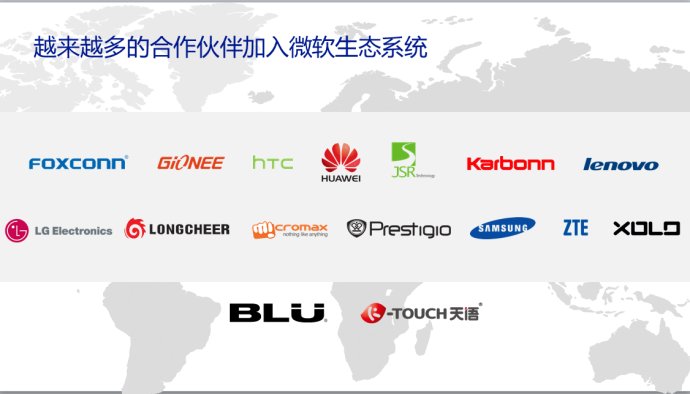
Microsoft’s policy change got a positive response from OEMs. At the MWC in February, Microsoft announced that nine manufacturers — ZTE, Lenovo, Gionee, JSR, Longcheer, Foxconn, LG, Karbonn, XOLO — joined the Windows Phone camp. But OEM enthusiasm didn’t stop there; at the subsequent Build conference and Qualcomm partner summit, four more OEMs — Micromax, K-Touch, and others — were added. Additionally last month, Hisense also held a 4G new-product and Windows Phone cooperation launch event, announcing it joined Microsoft’s Windows Phone platform.
Among the growing list of Windows Phone device makers, ZTE, Lenovo, Gionee, and Hisense are all deeply rooted in the Chinese domestic market — not only understanding Chinese consumers’ smartphone consumption habits but also having broad sales channels and great market influence in China, helping Windows Phone expand more effectively in the Chinese market. In other country markets, new OEM Karbonn is an Indian local manufacturer, and Blu is one of Latin America’s largest mobile brands; these OEMs’ joining will help Windows Phone enter the vast Indian and Latin American markets.
To help those who previously focused on the Android platform launch Windows Phone devices faster and at lower cost, Microsoft, together with chipmaker Qualcomm, launched the Qualcomm Reference Design program for Windows Phone. With the Qualcomm Reference Design, many device makers’ existing Android phones can be very easily ported to the Windows Phone platform, greatly reducing device production and R&D costs and speeding up new device launches. And removing the hardware requirement for virtual buttons makes it more convenient for OEMs to directly use original Android device molds to produce Windows Phone phones.
While announcing cooperation with Qualcomm, Microsoft specially launched a Windows Hardware Partner Portal for new OEMs, helping more people understand the Windows Phone device manufacturing process and guiding device makers unfamiliar with the Microsoft platform on how to use the QRD reference design to quickly manufacture Windows Phone devices.
 Windows Phone